

The importance of accurate, robust dental records cannot be overstated
When US president Abraham Lincoln was shot dead in 1865, the perpetrator John Wilkes Booth escaped to Virginia. Discovered hiding in a barn, he was shot dead on the spot. But for many years afterwards, rumours circulated that Booth had escaped and was still alive. So strong was the national unease, Booth’s body was disinterred and examined again in 1893. The family dentist identified the body by the odd formation of his jaw that had been noted in his dental records during a visit for the restoration of a filling.[i]
Similarly at the end of World War 2, rumours were rife that Adolf Hitler had escaped and were only quashed when remnants of a bridge were identified in the pieces of his jaw that matched his dental records, and was confirmed by his dentist Hugo Blaschke.i
While extreme examples, they do illustrate just how important accurate dental records can be. They are a valuable tool for identifying individuals, especially in situations where traditional methods may not be possible, such as in cases of accidents, natural disasters, or criminal investigations.
Each person’s dental structure is unique, and dental records can help in establishing a person’s identity. By comparing dental records, such as dental x-rays, bite marks, and other dental evidence, forensic experts can also identify suspects, victims, or missing persons in criminal investigations or mass disaster incidents.[ii]
Of course, good record keeping is a regulatory requisite of competent professional dental practice.[iii] It is essential to the provision of safe and effective care. In general, the function of good record keeping is to support:
- patient care and self-empowerment
- interdisciplinary and patient/clinician communication
- effective clinical judgements and evidence the decision-making process
- continuity of care
- clinical and medico-legal risk analyses and complications mitigation
- clinical audit, research, allocation of resources and performance planning.[iv]
Dental records provide important information about an individual’s oral health history, including previous dental treatments, allergies, medications, and any existing conditions. This information is vital for dental professionals to provide appropriate and personalised care, monitor progress, and make informed treatment decisions.
They are also essential for legal purposes. They can be used as evidence in legal cases, insurance claims, personal injury cases, and compensation claims. Detailed documentation of oral health, treatments, and conditions can support claims or refute false allegations.
Digital technology has revolutionised the record keeping process, of course, allowing the dental team to work faster, smarter and more efficiently than ever before.[v] There was a time, not so long ago, when a patient record would have consisted of paper forms held in a paper folder with written notes and some radiographic films.
The advent of electronic records including digital images and scans provide safer, quicker and more detailed information than traditional technologies. When data is digital, the dentist and patient can benefit from high quality clinical information, enhanced diagnostic capabilities and more efficient implementation of major treatment plans.
 Patients always have the right to access their notes and may request a copy of their records. Electronic records are easily shared and allow patients to review and fully consider their options when deciding and consenting to a course of treatment, for example. This transparency can foster a sense of trust between dental professionals and patients, and encourages collaboration in treatment decision-making which is always a positive.
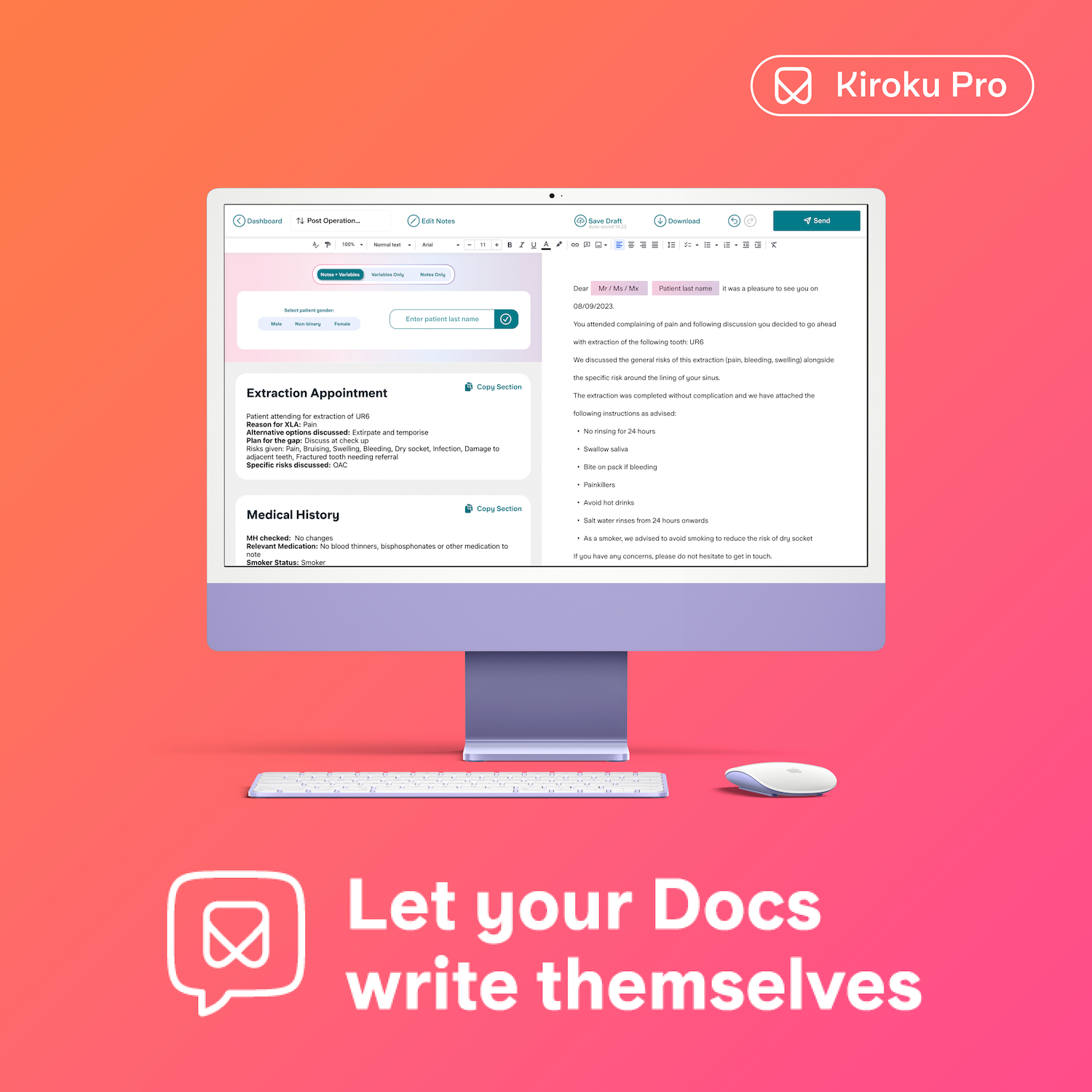
To help busy dental professionals, Kiroku, the AI digital note taking platform, has introduced Kiroku Docs that converts clinical notes – including those from patient records – into documents at the click of a button. Kiroku Docs can generate many different types of documents, including consent forms, treatment planning letters and referral letters, from the notes taken. Each fully customisable document template pulls the relevant information from the notes guaranteeing no duplication of effort. Given that clinicians need to communicate with a wide range of people (from patients and specialists through to insurance companies), Kiroku Docs can also adapt the language it uses. For example, it can translate complex clinical terminology into layman’s terms.
With dental professionals being required to record ‘complete, accurate and contemporaneous’ notes and the GDC specifying that you must record ‘as much detail as possible’,[vi] the advent of the digital age makes a patient’s dental records more robust than ever. They help ensure accurate and personalised dental care while serving as a valuable resource in various legal and forensic contexts. They give patients a greater involvement and understanding of their care too which serves to improve the entire dental experience. Now that’s really something to take note of.

To find out more about Kiroku, or to start your free trial, please visit trykiroku.com

[i] Balachander N, Babu NA, Jimson S, Priyadharsini C, Masthan KM. Evolution of forensic odontology: An overview. J Pharm Bioallied Sci. 2015 Apr;7(Suppl 1):S176-80. doi: 10.4103/0975-7406.155894. PMID: 26015703; PMCID: PMC4439663. [Accessed November 2023]
[ii] Charangowda BK. Dental records: An overview. J Forensic Dent Sci. 2010 Jan;2(1):5-10. doi: 10.4103/0974-2948.71050. PMID: 21189983; PMCID: PMC3009547. [Accessed November 2023]
[iii] Care Quality Commission https://www.cqc.org.uk/guidance-providers/dentists/dental-mythbuster-8-dental-care-records
[iv] NHS England https://www.england.nhs.uk/publication/dental-record-keeping-standards-a-consensus-approach/
[v] Delrose DC, Steinberg RW, The clinical significance of the digital patient record, The Journal of the American Dental Association, Volume 131, supplement 1, 2000, Pages 57S-60S, ISSN 0002-8177, https://doi.org/10.14219/jada.archive.2000.0404 [Accessed November 2023]
[vi] General Dental Council https://standards.gdc-uk.org/pages/principle4/principle4.aspx [Accessed November 2023]


