


In dentistry, pain – particularly toothache – remains one of the most common reasons for patients seeking treatment, but is often more than a simple, short-term issue. The oral cavity and teeth are heavily innervated by the trigeminal nerve, one of the largest cranial nerves.[i] Due to this, oral pain is more than an isolated issue and presents in various intensities – bringing great discomfort to most, and can even be debilitating for some.
Toothache can arise suddenly and affect every day wellbeing like sleeping, working, mood, and confidence. Dental professionals have both the duty to identify the clinical cause of toothache and to guide patients through safe and effective methods of management until clinical treatment is completed, if necessary.
The nature of toothache
Toothache presents in several ways, from transient or intermittent pain, to more acute or persistent pain.[ii] The underlying causes are just as varied: reversible pulpitis, for example, can produce rapid, sharp twinges of localised pain when exposed to thermal stimuli – this fast pain conduction is due to the nerve pathway of myelinated A-delta fibres (A∂ fibres).[iii] Conversely, unmyelinated C-fibres are responsible for slower pain conduction which is difficult to localise – their pain activation signifies that the pulp damage could be irreversible.[ii]
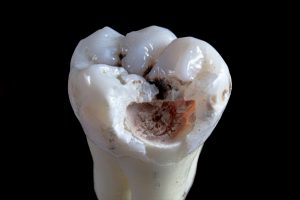
Caries-related irreversible pulpitis is caused by the progression of bacterial infection and inflammation that decays into the dental pulp which can lead to the eventual need for root canal treatment.[ii] Other causes of toothache include cracked teeth, occlusal trauma,[iv] exposed dentine, and more.[v]
Starting with emotional support
Dental professionals deal with a plethora of intense cases daily. However, regardless of the extremity of a case, something that may seem slightly minor in contrast, like toothache, can feel colossal to a patient – particularly when it is evidenced to interfere with eating or socialising.
Anxiety and fear can exacerbate the sensation of pain and many patients often fear that oral pain can mean something serious that will worsen whilst anxiously awaiting a dental appointment.[vi] For professionals, treating this unease is as important as clinical treatment – particularly in preventing patients from assuaging these feelings and sourcing their own relief with remedies that could do more harm than good.
Guiding efficient self-care
There are many “home-remedies” that patients might attempt to find relief. These are often unverified methods, and can actually inhibit or exacerbate the initial problem such as alcohol-based mouth washes or hot compresses.[vii] Moreover, though “home remedies” might seem to ease anxieties and mildly diminish discomfort, a recent study evidenced that only 26% of individuals found that they helped “a lot”, with 10.6% declaring them “not at all” effective.[viii]
As such, dental professionals should intervene, with safe, pharmacy-available options being recommended until appointments and treatments are available. In discussing self-care, each minor detail has an impact on the reception and fulfilment of such – small details matter. Patients that understand their pain, and available relief options, are more likely to progress confidently and compliantly in their path to recovery.[ix]
Advising from the roots up
Long-term toothache solutions begin with addressing the cause – from caries removal or endodontic therapy to full extraction or occlusal adjustment. Yet, to bridge the gap between presentation and treatment, evidence-based self-management strategies are most useful, especially as alternatives to hindering “home-remedies”. Primarily, systemic analgesics are both accessible and effective methods of pain relief – which should be recommended with appropriate advice.
Alongside systemic medication, topical treatments can offer a huge consolation. The targeted nature of the medication makes relief more localised and source-specific. As such, offering patients a method of self-managing their discomfort can assist them both physically and psychologically – allowing them to regain control over their pain and recovery. Practitioners should explain how topical gels work, the recommended frequency of use, and when to seek professional intervention.[x]
Reliable, targeted relief
 OrajelTM has paved the way of dependable and effective oral pain management for decades. Within its range, OrajelTM Dental Gel is the ideal solution for toothache pains. Offering rapid toothache relief where and when you need it most – delivering localised treatment in under 2 minutes. The gel contains 10% w/w benzocaine, a local anaesthetic that temporarily blocks the pain signal pathways along the nerves – numbing the area for up to 2 hours of relief. OrajelTM also offer an Extra Strength option, containing 20% w/w benzocaine, for those seeking a stronger solution to their discomfort. The OrajelTM Extra Strength Gel can be found at the pharmacy and should not be used consistently.

Offering real support
Toothache extends far beyond solely the oral pain, but can impact major aspects of a patient’s wellbeing – from eating and sleeping, to socialisation, and more. Dental teams can best assist their toothache patients firstly by offering empathy-driven understanding into the pain and anxieties associated with their suffering.
Furthermore, self-management advice is critical in ensuring the avoidance of detrimental ”home-remedies”, guaranteeing that patients are sourcing evidence-based solutions whilst awaiting professional treatment.
Click here to explore the full Orajel range

Author: Sumera Bashir Medical Affairs & Scientific Engagement Lead

[i] Huff T, Weisbrod LJ, Daly DT. Neuroanatomy, Cranial Nerve 5 (Trigeminal) [Updated 2024 Apr 20]. In: StatPearls [Internet]. Treasure Island (FL): StatPearls Publishing; 2025 Jan-. Available from: https://www.ncbi.nlm.nih.gov/books/NBK482283/
[ii] Timmerman A, Parashos P. Management of dental pain in primary care. Aust Prescr. 2020 Apr;43(2):39-44. doi: 10.18773/austprescr.2020.010. Epub 2020 Apr 1. PMID: 32346209; PMCID: PMC7186276.
[iii] Iaculli F, Rodríguez-Lozano FJ, Briseño-Marroquín B, Wolf TG, Spagnuolo G, Rengo S. Vital Pulp Therapy of Permanent Teeth with Reversible or Irreversible Pulpitis: An Overview of the Literature. J Clin Med. 2022 Jul 11;11(14):4016. doi: 10.3390/jcm11144016. PMID: 35887779; PMCID: PMC9321233.
[iv] Fukuda KI. Diagnosis and treatment of abnormal dental pain. J Dent Anesth Pain Med. 2016 Mar;16(1):1-8. doi: 10.17245/jdapm.2016.16.1.1. Epub 2016 Mar 31. PMID: 28879289; PMCID: PMC5564113.
[v] Xinru Li, Qihui Wang, Yirong Sun, Guoliang Wang, Congxiao Zhang, Jianxun Ding, (2025), Advances in physical and chemical strategies for dentin hypersensitivity therapy, Journal of Advanced Research
[vi] Woo AK. Depression and Anxiety in Pain. Rev Pain. 2010 Mar;4(1):8-12. doi: 10.1177/204946371000400103. PMID: 26527193; PMCID: PMC4590059.
[vii] Alcohol-based mouthwash may increase the risk of gum disease, cancers (no date) Medical News Today. Available at: https://www.medicalnewstoday.com/articles/alcohol-based-mouthwash-may-disrupt-oral-microbiome-leading-to-gum-disease-and-certain-cancers (Accessed: 06 November 2025).
[viii] Cohen, L.A., Bonito, A.J., Akin, D.R., Manski, R.J., Macek, M.D., Edwards, R.R. and Cornelius, L.J. (2009), Toothache pain: Behavioral impact and self-care strategies. Special Care in Dentistry, 29: 85-95. https://doi.org/10.1111/j.1754-4505.2008.00068.x
[ix] Goldsmith, L.J., Suryaprakash, N., Randall, E. et al. The importance of informational, clinical and personal support in patient experience with total knee replacement: a qualitative investigation. BMC Musculoskelet Disord 18, 127 (2017). https://doi.org/10.1186/s12891-017-1474-8
[x] Bérubé, Mélaniea,b,c,*; Verret, Michaela,d,e; Bourque, Laurencea; Côté, Carolinea,b; Guénette, Linea,c,f; Richard-Denis, Andréaneg,h; Ouellet, Simona,b,i; Singer, Lesley Norrisc,j; Gauthier, Lynna,c,k,l,m,n; Gagnon, Marie-Pierrea,b,l; Gagnon, Marc-Aurèlea; Martorella, Géraldineo,p. Educational needs and preferences of adult patients with acute pain: a mixed-methods systematic review. PAIN 165(12):p e162-e183, December 2024. | DOI: 10.1097/j.pain.0000000000003288


