




Dental professionals will always endeavour to recommend the best solutions to their patients. This isn’t only a professional requirement, as the General Dental Council’s Standards for the Dental Team notes patients should be provided with care and advice that is in their best interest, but a simply human one too.
The science behind dentistry, backed by centuries of research, has led to oral hygiene routines and treatments having increasingly predictable outcomes. When a professional recommends that a patient changes their approach to daily toothbrushing, or undergoes care to rectify an oral health issue, it must therefore be supported by clinical research.
Making recommendations based on proven facts is important, especially in a world where access to cheaper alternatives – from electric toothbrushes and water flossers from brands that aren’t household names, to restorative treatment abroad – are so prominent, and understandably appealing to patients. It’s the responsibility of dental professionals to ensure patients are aware of the highest-quality, safest, and most importantly, clinically-proven choices available to them.
The importance of proven solutions
Patients should understand the need for their oral hygiene routines and treatments in order to fully engage with treatment. For younger patients, these explanations can be simplified; brushing your teeth twice a day keeps your teeth healthy, and the proof provided is with pictures of people with bright white smiles. Adult patients will need to hear the same message, but dental professionals can have a more in-depth conversation about the differences between the options available.
It is in these conversations that the power of clinical findings can succeed. For example, clinicians may recommend a patient changes from a manual toothbrush to an electric toothbrush. These are now well known by patients, but the decision to invest could be supported by mentioning that research has found the latter is more effective for reducing plaque, gingivitis, calculus and staining.[i] It may then be prudent to refer to findings on specific solutions, ensuring that patients select products that will make a difference to their oral hygiene; an individual that invests in an unproven and potentially unsafe product will not want to hear that they spent their money on an ineffective item.
Recommendations may be based on previous clinical experience, items that have been identified when doing extra research, or from trusted sources such as the Oral Health Foundation’s approved products. These items, marked by the charity’s ‘Approved’ smiley-face logo, give added assurance to patients by noting that the claims made are clinically-proven and not exaggerated.[ii] Clinicians could advise that patients look out for such signs when considering new items, and doing further research into products before purchase.
Picking up new routines
Interdental cleaning or water flossing are known within professional circles to be useful additions to daily cleaning, aiding access to plaque and bacteria in interdental spaces. When introducing a new habit to the oral hygiene routine, it’s vital that patients have access to safe, proven solutions.
In the literature, water flossing and conventional interdental cleaning have been found to reduce plaque accumulation, gingival inflammation and bleeding across a range of patient populations.[iii] Daily water flossing has also been shown to reduce results of poor oral hygiene, including oral malodour, by alleviating gingival inflammation and reducing oral anaerobes.[iv] When dental professionals talk to patients about the potential need for such a solution, citing up-to-date research findings shows they are not only putting clinical needs first, but justifying their recommendations.
The literature has found that when patients agree with a clinician’s advised course of action, it was a sign of increased trust – this agreement will only come when a patient feels sufficiently informed.[v]
Avoid imitations
In the online age, it has never been easier for patients to get their hands on new oral healthcare products. When choosing individual products, it’s once again vital that individuals find those that are backed by science, and not simply manufactured to imitate those that are proven to provide clinical benefits.
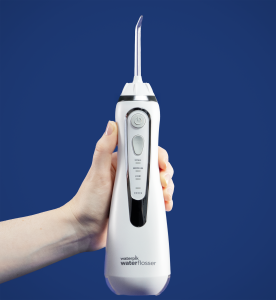 Water flosser solutions from Waterpik™, including the Cordless Advanced water flosser, are backed by 80+ research studies to ensure that patients choose products that they trust. The Cordless Advanced is a rechargeable water flosser with 4 flossing tips and a 360º rotating head, for complete access to the dentition.
The literature shows it can remove up to 99.9% of plaque from treated areas in as little as 3 seconds,[vi] and it is up to 2x as effective as string floss for removing bacterial plaque and improving gingival health.[vii]
Clinicians need to support patients by providing recommendations that are based on scientific fact. This ensures that individuals can trust the dental team, and make effective, safe and predictable changes to their oral health.

For more information on WaterpikTM water flosser products visit www.waterpik.co.uk. WaterpikTM products are available from Amazon, Costco UK, Argos, Boots and Tesco online and in stores across the UK and Ireland.
 Author: Rachel Bennett
Rachel Bennett is a dental hygienist working at Bupa Dental Care Leeds and Churchview Dental Care, where she offers high-quality care to her patients. She has been a professional educator for Waterpik™ for years, and will talk about the importance of water flossing and her experience with Waterpik™ solutions.
[i] Yeh, C. H., Lin, C. H., Ma, T. L., Peng, T. Y., Vo, T. T. T., Lin, W. N., … & Lee, I. T. (2024). Comparison between powered and manual toothbrushes effectiveness for maintaining an optimal oral health status. Clinical, Cosmetic and Investigational Dentistry, 381-396.
[ii] Oral Health Foundation, (N.D.). Approved Products. (Online) Available at: https://www.dentalhealth.org/Pages/Category/approved-products [Accessed December 2025
[iii] AlMoharib, H. S., Alqasem, A., Almusfer, G., Aldosari, M. A., & Almadhoon, H. W. (2024). The effectiveness of water jet flossing and interdental flossing for oral hygiene in orthodontic patients with fixed appliances: a randomized clinical trial. BMC Oral Health, 24(1), 498.
[iv] Xu, X., Zhou, Y., Liu, C., Zhao, L., Zhang, L., Li, H., … & Cheng, X. (2023). Effects of water flossing on gingival inflammation and supragingival plaque microbiota: a 12-week randomized controlled trial. Clinical oral investigations, 27(8), 4567-4577.
[v] Adekunle, T. A., Knowles, J. M., Hantzmon, S. V., DasGupta, M. N., Pollak, K. I., & Gaither, S. E. (2023). A qualitative analysis of trust and distrust within patient-clinician interactions. PEC innovation, 3, 100187.
[vi] Gorur, A., Lyle, D. M., Schaudinn, C., & Costerton, J. W. (2009). Biofilm removal with a dental water jet. Compendium of continuing education in dentistry (Jamesburg, NJ: 1995), 30, 1-6.
[vii] Mancinelli‐Lyle, D., Qaqish, J. G., Goyal, C. R., & Schuller, R. (2023). Efficacy of water flossing on clinical parameters of inflammation and plaque: a 4‐week randomized controlled trial. International Journal of Dental Hygiene, 21(4), 659-668.


