




There is a lot of concern about declining attention spans in younger generations. Between lockdowns of the pandemic and the boom of social media, screen time has increased. In particular, the fast-paced environment of TikTok has created an addictive, constant feed of short videos that has had a genuine impact on cognitive function: both primary and secondary school students now struggle to focus on school-related activities for more than 10 minutes.[i]

Beyond school, shorter attention spans can impact numerous everyday activities. The oral hygiene routine is no exception, and dental practitioners must ensure that paediatric patients remain focused and engaged with their oral health. One way of doing so is through the gamification of dental care.
Everything’s a game
Gamification is the use of features to increase target behaviours and engagement. Its application enables users to perform tasks effectively by making them more enjoyable.[ii] In everyday life, gamification has flourished: it’s the use of smart watches to record heart beats and exercises, the levelling up on language-learning services, the collecting of membership points with every supermarket shop. All are designed to keep people coming back.
Continuously watching fast-paced videos interferes with a child’s capacity to perform tasks correctly, decreasing their ability to control impulses and hardwiring the brain to expect instant gratification.[iii] This means that the constant release of dopamine primes the body for a rush. As such, finding ways to maintain interest in other activities is essential to produce the best results – the quality of toothbrushing won’t be as high when attention is elsewhere.
Game on
Studies on the gamification of healthcare as a whole have found positive changes. In particular, patient motivation has increased due to the greater engagement in the ‘games’ and the learning experiences it provides. Moreover, patients with more chronic conditions have reported better self-management and a stronger adherence to their treatment or recommended actions.[iv]
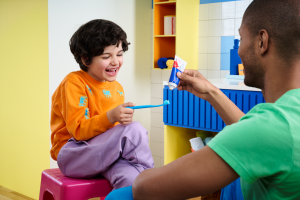
For oral health, gamification can improve motivation – especially for young siblings who can compete with one another. A difficulty arises with just how to gamify the daily oral hygiene routine without making it too competitive. Across other activities, speed is often the mark of success – whoever does something the fastest is the winner. This is problematic for toothbrushing because the two-minute recommendation must be followed for optimal hygiene outcomes. Similarly, more frantic brushing within that two-minute period may cause gingival bleeding by being too rough. This gives toothbrushing limitations for gamification: how can it be engaging and competitive without being fast or too rough?
Rewarding excellence
The introduction of elements like badges, levels and leader boards can be a great way of enhancing the toothbrushing experience and increasing compliancy. Children that complete a two-minute brush with constant focus and care should be rewarded with a badge or sticker, especially if they have previously struggled with brushing their teeth correctly. Once children understand and maintain the rewardable level of toothbrushing, it should be instilled in them for the future and rewards won’t be needed.
However, there are two likelihoods to consider with any ‘game’. First, there is an increased propensity for children to cheat.iv Whilst this is difficult to do with a parent/guardian watching over, children may find ways around not brushing their teeth. Plaque disclosing tablets can help in this, identifying the effectiveness of the brushing and also helping the child to understand why they need to brush. The second likelihood is that children may lose interest in the long run – if they are consistently rewarded, the impact is dulled.iv
Inserting some fun
Whilst it is easy to point a finger at social media as a cause for lowered attention spans, dental practitioners should also highlight the benefits to parents/guardians. Apps like TikTok can be great tools for education, with a growing number of dental brands and influencers highlighting oral health habits on them. This enhances a child’s engagement with their dental hygiene.
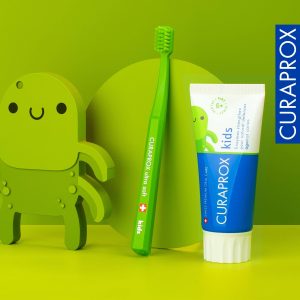 The Oral Health Starter Kit for Kids is an unmissable Curaprox product that motivates paediatric patients to look after their teeth. Alongside an ultra-soft toothbrush and watermelon flavour toothpaste, the set includes a tooth loss chart, tooth fairy letters and envelopes and a safe-keeping pouch. Not only do these make toothbrushing more interactive for the child, but they highlight the importance of consistent oral care for the future.
The gamification of everyday activities has many pros and cons, but it helps compete against the lowering attention spans of younger generations. Dental practitioners should detail the ways in which parents/guardians can increase toothbrushing compliancy for their children, and turn oral hygiene from chore to fun activity.

To arrange a Practice Educational Meeting with your Curaden Development Manager please email us on sales@curaden.co.uk
For more information, please visit www.curaprox.co.uk and www.curaden.co.uk
 Andrew Turner – Curaden UK Head of Marketing UK & Ireland
[i] Opara, E., Adalikwu, T.M.-E. and Tolorunleke, C.A. (2025). The Impact of Tiktok’s Fast-Paced Content on Attention Span of Students. The Impact of Tiktok’s Fast-Paced Content on Attention Span of Students, [online] 1(1). doi:https://doi.org/10.20944/preprints202501.0269.v1.
[ii] Fijačko, N., Gosak, L., Cilar, L., Novšak, A., Creber, R.M., Skok, P. and Štiglic, G. (2020). The Effects of Gamification and Oral Self-Care on Oral Hygiene in Children: Systematic Search in App Stores and Evaluation of Apps. JMIR mHealth and uHealth, 8(7), p.e16365. doi:https://doi.org/10.2196/16365.
[iii] Jargon, J. (2023). This Was Supposed to be the Antidote for TikTok Brain. It’s Just as Bad. [online] WSJ. Available at: https://www.wsj.com/tech/personal-tech/this-antidote-for-tiktok-brain-is-also-a-problem-d20ce978 [Accessed 15 Aug. 2025].
[iv] Al-Rayes, S., Al Yaqoub, F.A., Alfayez, A., Alsalman, D., Alanezi, F., Alyousef, S., AlNujaidi, H., Al-Saif, A.K., Attar, R., Aljabri, D., Al-Mubarak, S., Al-Juwair, M.M., Alrawiai, S., Saraireh, L., Saadah, A., Al-umran, A. and Alanzi, T.M. (2022). Gaming elements, applications, and challenges of gamification in healthcare. Informatics in Medicine Unlocked, [online] 31, p.100974. doi:https://doi.org/10.1016/j.imu.2022.100974.


