




The design of a dental practice has an impact on many aspects of the business. Everything from the patient experience to the professional workflow, and the health and safety of all on the premises, will be influenced by the layout of the practice. For principals, whether starting from scratch or refreshing an existing business, it is crucial to integrate intentional design elements that will add value to patients, the professional team and the business.
Creating calm and comfort
Dental practice design can have an emotional and psychological impact on patients from the moment they walk through the doors. Research has found that design features such as ambient lighting, indoor plants, and seating options can help to reduce stress levels among patients.[i] Colour psychology – with a focus on blues, pinks, greens, and yellows – can also be implemented within the décor to lower patient anxiety.[ii] A clutter-free reception and waiting area contributes to reduced tension and a more calming atmosphere as well.[iii]
Boosting productivity
The research also demonstrates the benefits of ergonomic practice design for the wellbeing of professionals. When ergonomic principles are applied – such as dental chairs or stools that improve posture – professional health is protected and the risk of musculoskeletal disorders is reduced.[iv]
Improved ergonomics have several other benefits for the business, including increased productivity.[v] This is achieved not only by minimising the risk of professional injuries and staff absence, but also has positive implications for daily workflows across the practice, which can lead to improved patient satisfaction. Spatial design has been shown to increase the efficiency of the healthcare team, allowing faster patient care with no compromise on the quality of care delivered.[vi]
Design in decontamination
One of the most important benefits of effective dental practice design is the enhanced health and safety standards it facilitates for patients and staff alike. The decontamination workflow requires significant attention in order to ensure practice compliance, streamline processes, and maintain reliability for complete peace of mind.
A dirty-to-clean workflow should be implemented for the cleaning, disinfection and sterilisation of reusable instruments.[vii] Best practice guidelines encourage practices to assign a separate room. As such, the physical layout of the space should ensure that dirty and clean items are kept apart. The objective is to minimise the risk of contaminating clean instruments via inadvertent contact with dirty items.
For practices without the space for a dedicated decontamination room, the instrument reprocessing area must be located as far from the dental chair as possible. Measures are also required to reduce the risk of exposure to bacterial aerosol, such as not manually washing instruments or using an ultrasonic cleaner without a lid when a patient is in the room.[viii]
Safety in action
Achieving this dirty-to-clean workflow relies on a carefully designed physical environment. Firstly, the space should be uncluttered, with places for all equipment and instruments to be kept tidy. The ‘dirty’ area or room should be set up to receive used instruments. Initial cleaning and disinfection should occur adjacent to the dirty area. Manual cleaning is possible at this point, although a washer disinfector affords several advantages over manual processes by automating and validating this step in the workflow.
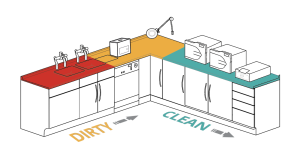
After visual inspection of the instruments, they are then due for sterilisation in the autoclave, which should be situated in the clean area as far from the dirty receiving area as possible. Figure 1 offers an example of how the decontamination room could be designed and where each piece of equipment may be situated in relation to others.
Expert advice and support
Whether you are updating your existing practice design, expanding your surgeries or setting up a new squat practice, meticulously planning the layout is crucial for success. From your entrance area to reception and the waiting room, the surgery and the bathrooms, your patients will expect a modern, comfortable, and safe space.
To achieve all this while managing budgets and future-proofing the practice, it can be invaluable to seek the advice of specialists in their respective fields. For example, Eschmann is the expert in instrument decontamination, and the team is more than happy to provide guidance and support on the design of your infection control area(s). With years of experience and extensive market knowledge, Eschmann offers bespoke advice, industry-leading equipment and ongoing support that will help you elevate your safety standards no end.
Thoughtful practice design will impact the team and patients in a number of ways. The right layout can improve the patient experience by promoting positive emotions and increasing efficiency of their care. Professionals also benefit from improved ergonomics and productivity. The design of the decontamination area is particularly important for the health and safety of all.
For more information on the highly effective and affordable range of decontamination solutions available from Eschmann, please visit www.eschmann.co.uk or call 01903 753322
 Author: Nicky Varney Head of Marketing
[i] Emami M, Pazhouhanfar M, Stoltz J. Evaluating Patients’ Preferences for Dental Clinic Waiting Area Design and the Impact on Perceived Stress. Buildings. 2024; 14(10):3160. https://doi.org/10.3390/buildings14103160
[ii] Rafatjou R, Ahmadi B, Farhadian M, Moghadam NE. Evaluation effect of color in dental office and dentist’s uniform while using two different distraction techniques on injection anxiety of 6-9 years’ old children referring to Hamedan Dental School: Randomized clinical trial. Dent Res J (Isfahan). 2021 Sep 25;18:71. doi: 10.4103/1735-3327.326644. PMID: 34760062; PMCID: PMC8543103.
[iii] Dedalo. Feng Shui. https://www.dedalostone.com/en/feng-shui/#:~:text=A%20cluttered%20and%20dirty%20environment,%2C%20improving%20overall%20well%2Dbeing. [Accessed November 2025]
[iv] Ahearn D, Sanders M, Turcotte C. (2010). Ergonomic design for dental offices. Work (Reading, Mass.). 35. 495-503. 10.3233/WOR-2010-0986.
[v] Sachdeva, Akshat & Bhateja, Sumit & Arora, Geetika. (2020). Ergonomics in Dentistry: A Comprehensive Review. Journal of Dental Research and Review. 7. 32-35. 10.4103/jdrr.jdrr_87_19.
[vi] Xuan, Xiaodong & Wu, Qi & Yang, Leiming & Cao, Wen & Zhang, Zixu & Zheng, Yihe. (2025). Interaction of nursing efficiency and spatial design in different departments: An agent-based modeling approach. Frontiers of Architectural Research. 10.1016/j.foar.2025.04.001.
[vii] HTM 01-05. Decontamination in primary care dental practices. Department of Health. https://www.england.nhs.uk/wp-content/uploads/2021/05/HTM_01-05_2013.pdf [Accessed November 2025]
[viii] Care Quality commission. Dental Mythbuster 18: Decontamination in the dental treatment room. July 2023. https://www.cqc.org.uk/guidance-providers/dentists/dental-mythbuster-18-decontamination-dental-treatment-room [Accessed November 2025]


