


The population’s general priority is shifting from possessions to experience, with society becoming more travel-driven – growing by 16% in just the past year alone.[i] From students taking gap-years and tired workers seeking sabbaticals to intrepid backpackers and professionals embracing a nomadic lifestyle, periods of travel have become far from uncommon for many.

This raises an interesting question for dental professionals on how the itinerant lifestyle affects oral health and how to best advise patients on the maintenance of such throughout their travels. With the continuum of oral care being an absolute priority, the reality involves far more – new diets, varied access to hygiene facilities, routines being disrupted entirely, and even altitude variations.
The vital steps involve understanding and preparing ahead for these risks, and advising patients on the correct protocol and strategies to manage them.
Diets and daily differences
Regardless of how diligent one is with their oral care, travelling presents unique changes that can impact the consistency and adequacy of hygiene maintenance. Primarily, new countries introduce diverse cultures that come with diet differences. Sugar-rich diets, combined with poor oral hygiene – something common when travelling – promote cariogenic microbes such as Streptococcus mutans.[ii] These acid-producing bacteria colonise the dental surface and damage the tooth structure, leading to caries and other oral complications.[iii]
Furthermore, accessibility can often take priority with tighter schedules and limited budgets – the convenience of low-cost, convenient food like crisps to snack on can become tempting, with a particularly starchy composition that can embed in hard-to-reach crevices.
Dental direction when travelling
Cost and time both play a role in the reasons behind avoiding a pre-travel dental check-up. This can be particularly detrimental for those who have had significant treatment in the past like implants or root canal therapy, who require more specific advice.
Furthermore, the risks associated with changes to lifestyle that come with vacations – like adventurous activities or alcohol-related injuries – create a danger-inducing environment for one’s oral health. Dental emergencies abroad follow varied protocols to those at home – which, without the right guidance sought from dental professionals prior to travelling, can be extremely detrimental.
Appropriate advice should always be offered by clinicians – supporting patients in their upcoming ventures: recommending dental-inclusive travel insurance, explaining what to do in practical emergencies, and adjusting to new cuisines and environments. This assistance extends to the general maintenance of everyday routines whilst travelling – such as keeping a fresh-water bottle for toothbrushing in places with contaminated tap water and fulfilling an appropriate, consistent oral care regime including fluoride and interdental cleaning.
Lacking a dental hygiene home
The adjusted environment can create difficulties – between limited private bathroom access and lack of clean water supplies, there are several potential disruptions to the oral hygiene routine. Overnight travel buses, energetic hostels, and stressful schedules can all contribute to skipped or hurried toothbrushing.
Next level oral care, such as interdental cleaning, is an even less patient-compliant sector of the routine – with the regular use of dental floss and other interdental cleaning tools being implemented by only 10-30% of adults.[iv] This is partly due to the technically challenging nature of the task, which is augmented further when combined with travel.
When interdental cleaning lacks consistency, the development of caries increases in conjunction. The strain on both toothbrushing and interdental cleaning, in combination with the other changes that travel endures, can lead to the greater progression of oral issues. For example, periodontitis, which progresses more rapidly in interdental spaces, making it integral that these areas are cleaned thoroughly when the oral cavity is experiencing so many cultural and environmental changes.[v]
Such exacerbated issues will likely require eventual clinical intervention – which is just another of the many risks of oral care alterations whilst travelling.
 Portable solutions
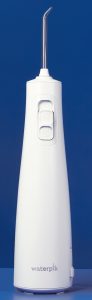
One of the best ways of maintaining great interdental hygiene is with clinically-proven water flossers. The #1 water flosser brand recommended by dental professionals is WaterpikTM – with specific products created to encompass everything travelling patients require for gold star hygiene. The Cordless Pulse offers an easy-fill reservoir for 45 seconds of continuous flossing, and is rechargeable with a sleek, portable design – making it perfect for travel, compact environments, and everyday use. Just 3 seconds of exposure removes approximately 99.9% of the plaque biofilm from treated areas, with 2 pressure settings available to suit each need.
Continuous oral care, no matter where
With travel – particularly long-term – becoming a more common experience, it is important that the unique risks associated are advised upon and managed appropriately. Though not all oral health threats are avoidable, preventive measures can significantly reduce the probability of dental-related repercussions. Advising on avoidable dangers and disrupted diets is extremely beneficial for travelling patients, whilst the recommendation of travel-suitable tools can mitigate the biggest hygiene threats that travel involves.
For more information on WaterpikTM water flosser products visit www.waterpik.co.uk.
WaterpikTM products are available from Amazon, Costco UK, Argos, Boots and Tesco online and in stores across the UK and Ireland.
Recommend by brand
[i] Money, V. (2025) From takeaways to travel: Data highlights a 16% jump in lifestyle spending this summer, Virgin Money PLC. Available at: https://www.virginmoneyukplc.com/newsroom/article/from-takeaways-to-travel-data-highlights-a-16-jump-in-lifestyle-spending-this-summer/ (Accessed: 04 November 2025).
[ii] Lemos JA, Palmer SR, Zeng L, Wen ZT, Kajfasz JK, Freires IA, Abranches J, Brady LJ. The Biology of Streptococcus mutans. Microbiol Spectr. 2019 Jan;7(1):10.1128/microbiolspec.gpp3-0051-2018. doi: 10.1128/microbiolspec.GPP3-0051-2018. PMID: 30657107; PMCID: PMC6615571.
[iii] Forssten SD, Björklund M, Ouwehand AC. Streptococcus mutans, caries and simulation models. Nutrients. 2010 Mar;2(3):290-8. doi: 10.3390/nu2030290. Epub 2010 Mar 2. PMID: 22254021; PMCID: PMC3257652.
[iv] Ng E, Lim LP. An Overview of Different Interdental Cleaning Aids and Their Effectiveness. Dent J (Basel). 2019 Jun 1;7(2):56. doi: 10.3390/dj7020056. PMID: 31159354; PMCID: PMC6630384.
[v] Umalkar YN, Jadhav VV, Paul P, Saoji KP. Comparative Evaluation of Cleaning Efficacy of Interdental Brush and Interdental Floss in Orthodontics Patients From Vidarbha Region: An Interventional Study. Cureus. 2023 Sep 29;15(9):e46191. doi: 10.7759/cureus.46191. PMID: 37905279; PMCID: PMC10613348.


