


Sharp objects are used every day in dental practices. As a result, clinical teams need measures in place to work safely, minimising the risk of injury to both professionals and patients. Colleagues need to understand how to handle sharp items safely, especially in clinical waste workflows, and this requires a reflection on training and regulations.
More importantly, all clinical team members who are exposed to sharp objects must be well-versed in these procedures, as it may make a significant difference to the prognosis of an injury.
Best practices
Two essential pieces of legislation make up the foundation of safe sharps management. First, the European Council Directive 2010/32/EU (the Sharps Directive) was introduced to prevent injuries and the spread of bloodborne infections and is aimed at hospital and healthcare workers. Then the Health and Safety (Sharp Instruments in Healthcare) Regulations 2013 added further information to allow for a more comprehensive fit with pre-existing legislation in Great Britain.[i]
Clinicians will be inclined to look elsewhere to widen their view; Health Technical Memorandum 01-05: Decontamination in primary care dental practices (HTM 01-05) adds detail surrounding the need for an infection control policy that has a focus on bloodborne virus transmission,[ii] whilst Health Technical Memorandum 07-01: Safe and sustainable management of healthcare waste (HTM 07-01) gives a comprehensive guide to safe sharps disposal.[iii]
To maintain safe disposal procedures, clinicians must have specially designed waste containers on hand. Sharps are never considered offensive waste, as they present an inherent injury hazard, and the offensive waste stream only uses a yellow and black-striped bag.3 A rigid sharps bin will reduce the risk of puncture, and it should have a lid that is closed at all times unless waste is being added or it is being emptied. Where liquid is present in the sharp, a small volume will be allowed in the waste container.
Using similar criteria, the relevant waste stream should be chosen for non-sharp clinical waste items. This includes following the colour code based on the type and severity of risk presented by each waste item.
Preventing needlestick injuries
It is the responsibility of the dental practice to manage the sharps risk presented by objects such as needlesticks at every opportunity.[iv] A risk assessment of each typical treatment provided in the dental practice is necessary.
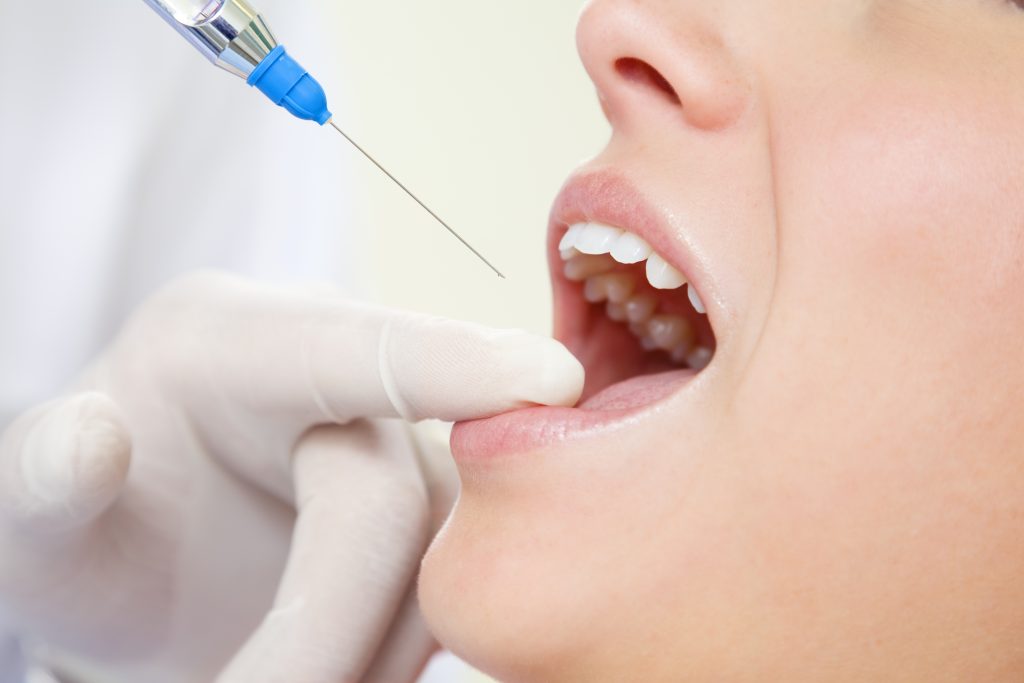
Typically, one would attempt to remove the risk entirely.4 However, the need for sharp items in many workflows, from providing anaesthesia to creating surgical incisions, means that it is impossible to evade such items. Instead, safer sharps processes should be provided. These may include personal protective equipment (PPE), a needle holder, or a needlestick recapping block that allows the sharp to be covered after use with just one hand.
Health and Safety (Sharp Instruments in Healthcare) Regulations 2013[v] once again suggest needle-free workflows should be accommodated where practicable. It also suggests needles and sharps with built-in features that minimise the risk of accidental injury, including a shield or cover that slides into place after use. It must be noted that such an item should never compromise patient care, and the clinician must be appropriately trained to use it.
It also highlights considerations for safety mechanisms, such as whether it is straightforward to use, thereby encouraging implementation; if it is integrated into the device, because then it cannot be lost or misplaced; or if there is a clear way to identify when the mechanism has activated correctly.5
The regulations reinforce the need for secure waste containers to be placed near the point of use. Instructions must also be close by. For ease of transport, a sharps waste bin may be situated on a dispensing trolley, which can be moved directly to the point of use. If an unexpected risk is created during an appointment, for example, a patient brings in their child to their appointment who may move around the room, clinicians must make suitable accommodations to minimise the risk of harm.
Choose safe solutions
Sensible and thoughtful selections at each instance of the sharps management workflow allow for injury risks to be reduced. Initial Medical provides clinical sharps waste bins that are optimised for patient and practitioner safety, with distinct colour coding to make segregation simple, alongside a sealed lid and disposal door. They are puncture-proof to avoid injury during transport, and Initial Medical team members are able to provide individualised advice for optimal safety.
Regularly reviewing regulations and guidance is key to protecting the dental team. Clinical waste management services are able to provide support alongside this, for a greater opportunity for risk prevention.
Author: Rebecca Waters – Rentokil Initial

To find out more, get in touch at 0808 304 7411 or visit the website today www.initialmedical.co.uk
About Initial Medical
Initial Medical set the standard in healthcare and infectious waste management in the UK, providing a reliable, effective, and fully compliant service built around customer needs and delivered by our highly trained local teams. We are ISO 9001:2015 accredited, with technology fully integrated into our operations, providing full traceability of service delivery, electronic waste documentation, and the best customer experience possible. We also offer innovative healthcare waste management services and infection control products, to help break the chain of transmission and prevent cross contamination.
Initial Medical are a company with a ‘World Class’ Health and Safety record, and ISO 45001:2018 accreditation. We are also accredited to ISO 14001:2015 environmental standards and pride ourselves on our sustainable approach with a focus on delivering eco-friendly products and operational solutions.
Media Enquiries:
For more information, please contact:
01227 265700
[i] Care Quality Commission, (2023). Dental Mythbuster 7: Use of safer sharps (Online) Available at: https://www.cqc.org.uk/guidance-providers/dentists/dental-mythbuster-7-use-safer-sharps [Accessed June 2026]
[ii] Department of Health, (2013). Health Technical Memorandum 01-05: Decontamination in primary care dental practices. (Online) Available at: https://www.england.nhs.uk/wp-content/uploads/2021/05/HTM_01-05_2013.pdf [Accessed June 2026]
[iii] NHS England, (2022). Health Technical Memorandum 07-01: Safe and sustainable management of healthcare waste. (Online) Available at: https://www.england.nhs.uk/wp-content/uploads/2021/05/B2159iii-health-technical-memorandum-07-01.pdf [Accessed June 2026]
[iv] Health and Safety Executive, (N.D.). Managing the risk of needlestick or sharps injuries. (Online) Available at: https://www.hse.gov.uk/healthservices/needlesticks/actions.htm [Accessed June 2026]
[v] Health and Safety Executive, (2013). Health and Safety (Sharp Instruments in Healthcare) Regulations 2013. (Online) Available at: https://www.hse.gov.uk/pubns/hsis7.pdf [Accessed June 2026]


