



 Dental professionals have been advising patients to floss for decades. The evidence is there. The message has been delivered, repeated, and reinforced at virtually every appointment for most patients’ lives. And yet, research consistently shows that only around 16% of adults floss habitually.[i] The gulf between knowing and doing – between getting advice and changing daily behaviour – is frustratingly wide, and remains one of the more persistent challenges in preventive dentistry. Understanding the gulf itself, and what can be done to narrow it, requires looking further than flossing and dental appointments and into the behavioural science of habit formation.
How habits form
A habit, in psychological terms, is a behaviour that has become automatic. The neurology involves the basal ganglia, a structure near the centre of the brain that encodes repeated behaviour sequences into efficient neural pathways. When a behaviour is performed consistently in the same context, in response to the same cue, the basal ganglia strengthen the association between stimulus and response until the behaviour executes with minimal conscious input.[ii] This is why brushing teeth feels effortless for most adults – it has been performed thousands of times in the same context, following the same cue, until it no longer requires a decision.
This underpinning habit loop has three components: cue, routine, and reward. The cue triggers the behaviour. The routine is the behaviour itself. The reward reinforces it, signalling to the brain that the loop is worth repeating. For a habit to form and persist, all three components need to be present and aligned.
Flossing fails – why?
Brushing can easily pass this habit test. It has a consistent environmental cue, a clear routine, and an immediate and perceptible reward: a fresher mouth. The behaviour is simple, quick, and the benefit is instantaneous. Interdental cleaning in its traditional form fails on several of those criteria simultaneously.
The cue for it is weak, as flossing is typically thought of as a separate behaviour to brushing, rather than an extension. Something people may do in addition to the routine, rather than as a part of it. Research from the London School of Hygiene and Tropical Medicine found that participants instructed to floss after brushing rather than before found it much easier to integrate strong flossing habits, and at the 8-month follow-up were found to have flossed more frequently.[iii] This finding reflects event segmentation theory: brushing itself is a more reliable cue for the behaviour that immediately follows it.
The routine itself can be demanding, too. Traditional string floss requires two hands, reasonable dexterity, a degree of technique, and time. For some, it does not feel natural or easy, and a behaviour that requires effort will also require more conscious motivation every time. And conscious motivation is not always available, whereas habit is.
Research has shown that it is the perceived barriers to flossing, rather than beliefs about its benefits, that most strongly differentiate habitual from non-habitual flossers.[iv] Barriers cited most frequently included fear of gingival bleeding, forgetting, and not having incorporated flossing into a daily oral care routine. Patients who do not floss are not, for the most part, unconvinced by its value. They are prevented from doing it by the perceived difficulty of the process relative to the perceived reward.
Changing the behaviour
 The patient’s belief in their own ability to perform the behaviour successfully also plays a role here. A patient who has already tried and failed to integrate flossing will have a lower belief, and success rate, than one who has never tried. Therefore, recommending the same techniques each time is not likely to lead to a different result.
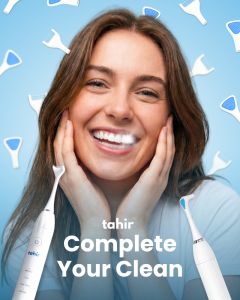
The Tahir Electric Flosser is a brand-new technique using tried and tested string floss action, directly addressing this nationwide compliance problem by addressing the barriers. One-handed operation addresses the dexterity requirement. The sonic action does the mechanical work. Four cleaning modes, including a Sensitive setting, address the discomfort barrier, which can cause many patients to associate flossing with pain and bleeding. The simplicity of the process makes it significantly easier to attach it as a habit to the end of a brushing routine, for a flossing experience that feels comfortable and effective.
Behaviour change is hard; dentists may know that better than anyone. The evidence for all of the benefits is strong, but the majority of patients are missing the ideal tool to close the gap between wanting to do it and establishing that habit. The science has told us what we needed for years – it’s time for the recommendation to catch up.

The Tahir Electric Flosser is available for patients at tahiroralcare.com and through Harrods. For practice enquiries and professional ordering, visit tahiroralcare.com
Author: Stefan White – Founder & Managing Director Tahir Oral Care

[i] Rotella, K., Bosma, M. L., McGuire, J. A., Sunkara, A., DelSasso, A., Gaff, M., Milleman, K., & Milleman, J. (2022). Habits, Practices and Beliefs Regarding Floss and Mouthrinse among Habitual and Non-Habitual Users. American Dental Hygienists” Association, 96(3), 46–58. https://jdh.adha.org/content/96/3/46
[ii] Smith KS, Graybiel AM. Habit formation. Dialogues Clin Neurosci. 2016 Mar;18(1):33-43. doi: 10.31887/DCNS.2016.18.1/ksmith. PMID: 27069378; PMCID: PMC4826769.
[iii] Judah G, Gardner B, Aunger R. Forming a flossing habit: an exploratory study of the psychological determinants of habit formation. Br J Health Psychol. 2013 May;18(2):338-53. doi: 10.1111/j.2044-8287.2012.02086.x. Epub 2012 Sep 18. PMID: 22989272.
[iv] Rotella K, Bosma ML, McGuire JA, Sunkara A, DelSasso A, Gaff M, Milleman K, Milleman J. Habits, Practices and Beliefs Regarding Floss and Mouthrinse among Habitual and Non-Habitual Users. J Dent Hyg. 2022 Jun;96(3):46-58. PMID: 35654569.


